Chandra Grahan on 3 March 2026: Timings, Sutak Kaal and What to Expect
Todays News IndiaPosted by vipulnaik on 2026-03-03 07:51:14 |
Share: Facebook | Twitter | Whatsapp | Linkedin Visits: 40
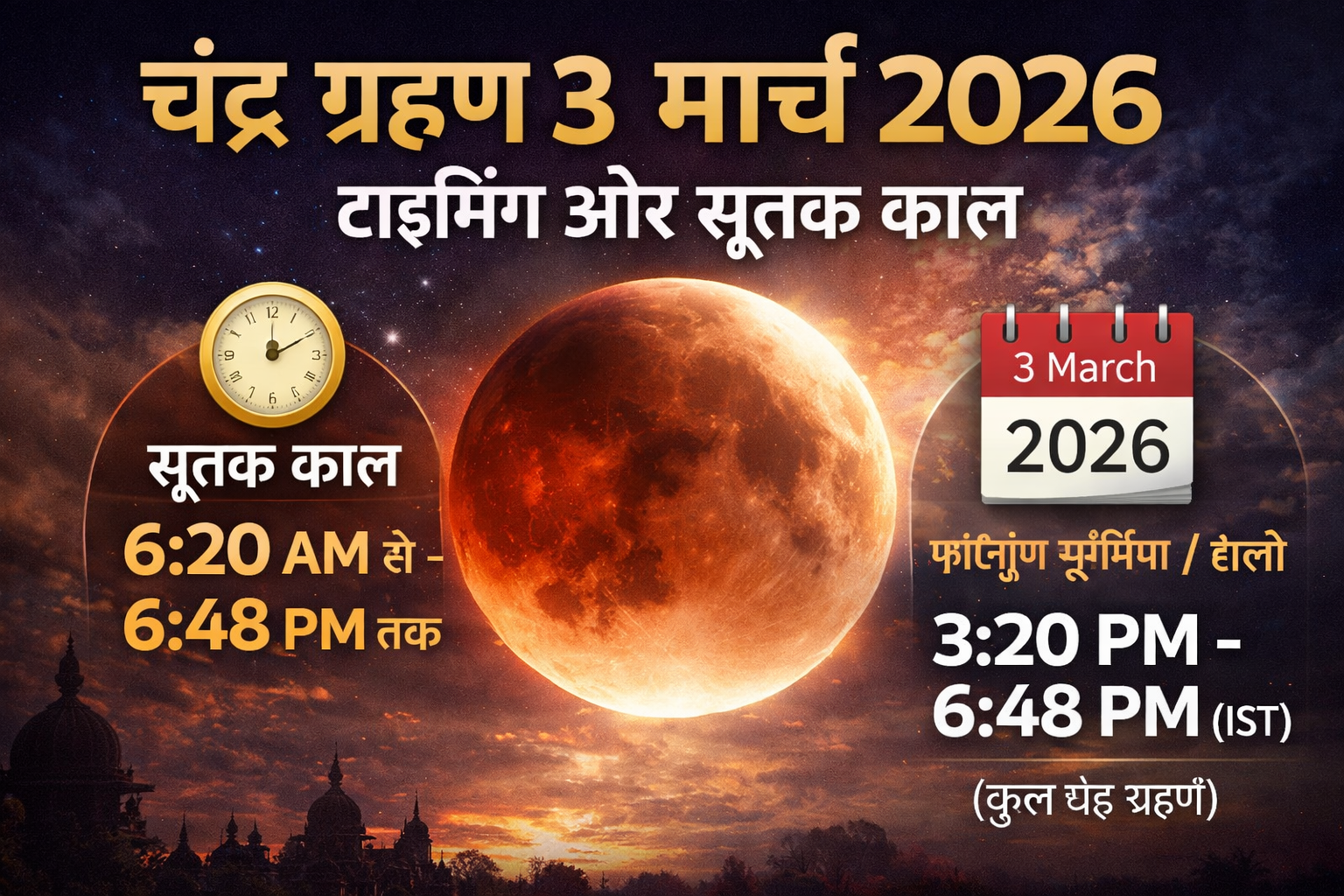
? Chandra Grahan on 3 March 2026: Timings, Sutak Kaal and What to Expect
On Tuesday, 3 March 2026, India will witness the first lunar eclipse of the year, known as Chandra Grahan. This celestial event falls on the day of Falgun Purnima and is expected to be a partial lunar eclipse. (The Financial Express)
According to astronomical timings, the eclipse will begin at 3:20 PM Indian Standard Time (IST) and continue till around 6:48 PM, with the total (blood moon) phase occurring between roughly 4:34 PM and 5:33 PM. (The Economic Times)
Because the Moon rises in many parts of India only in the late afternoon or early evening, observers will mostly see the eclipse during its later phases, typically around 6:20 PM to 6:47 PM, giving several regions about 20–25 minutes of visibility. (The Financial Express)
In Indian tradition, a period called Sutak Kaal is observed before and during an eclipse, during which certain religious or auspicious activities are avoided. For this event, Sutak Kaal starts early in the morning from about 6:20 AM and lasts until the eclipse ends in the evening. (AajTak)
The lunar eclipse also coincides with Holi festivities, making it an event of both astronomical and cultural interest. Eclipses are traditionally seen as significant periods in many communities, prompting special rituals, prayers, and observances around the timing of the event. (NDTV Profit)
Overall, this Chandra Grahan is expected to offer skywatchers in parts of India a chance to see a rare lunar shadow play across the Moon, even if only for a short period after moonrise. (The Financial Express)